UK Educational System
British education has a strong reputation worldwide, especially for the quality of its teaching standards. The British education system follows a slightly different model than many other countries: in Britain, the school system is completed in 13 years, while in many countries it is 12. The standard academic year starts in September or October and runs until June or July, although some courses are more flexible and offer a range of start dates.
Teaching quality in the UK is closely monitored. Every school is subject to regular independent inspection, and qualifications such as GCSEs and A Levels are recognised by universities and employers across the world. For international students, this combination of rigorous teaching, well-resourced schools and globally respected qualifications creates a clear pathway: from a strong academic foundation at school, through competitive sixth form study, to entry at some of the highest ranked universities in the world. A British education is an investment in a student's future prospects, both academic and professional.
Complete Guide to British Education
Below we explain the system in two ways: first by year of study, from primary education through to postgraduate level, and then by school type, so you can see exactly which institutions accept international students and how British Guardianship can support a placement at each.
Primary Education
Junior School: Year 3, Year 4, Year 5 and Year 6
Primary education is for children aged four or five up to 11 or 13. Terms you might hear are primary school, infant school, junior school, pre-preparatory school and preparatory school. The terms 'pre-preparatory' and 'preparatory' (or 'pre-prep' and 'prep') are most commonly used in the independent sector, such as boarding schools.
In the UK boarding school system, primary education begins with junior school. Pupils start at age 7 in Year 3 and progress until age 11 (Year 6). This is the earliest point at which international students can join a UK boarding school as full boarders.
Secondary Education
Senior School: Year 7, Year 8 and Year 9
Secondary education is for pupils aged 11 or 13 to 16. Terms you might hear for this level of education are secondary school, high school and senior school. The term 'senior school' is more commonly used in the independent sector, such as boarding schools.
Age 11 is the youngest at which boarders can join the first year of senior school, and it is an excellent entry point as it builds a strong foundation for the years ahead. It gives students the chance to experience many subjects, adapt to the UK educational system, make friends and achieve native-level English with excellent pronunciation. Age 13 (Year 9) is another common entry point for international students, as many boarding schools take in a new group of pupils at this stage.
GCSE Pathway: Year 10 and Year 11
In the last two years of secondary school (age 14 to 16), most pupils study for GCSE qualifications. Year 11 is an important year in the British education system as students take their GCSE exams. Students are usually aged 15 or 16 in Year 11, and it is the last year of compulsory secondary education in the UK. GCSEs are usually taken over two years, but the special one-year Year 11 Pathway allows students to take five to seven IGCSEs in a single year. Please contact us for more details.
Sixth Form: Year 12 and Year 13
A Level
The A Level is a school leaving qualification offered by educational bodies in the United Kingdom and the British Crown dependencies to students completing secondary or pre-university education. The two years of sixth form are often called the Lower Sixth (Year 12) and the Upper Sixth (Year 13), and most pupils sit their A Level exams at the end of Year 13, usually in three or four subjects.
Boarding schools offer a wide range of A Level subjects, including maths, the sciences (physics, biology and chemistry), history, geography, drama, IT, literature and foreign languages, alongside a full programme of extra-curricular activities.
A Levels are unique in providing an unrivalled depth of study in a few specialist subjects. After two years, students will have developed the kind of subject knowledge which, in many other countries, is only acquired during the first year at university. A Levels also develop students' broad study skills and their ability to think and argue critically, preparing them fully for the challenge of studying at world-class universities. A Level courses are the only possible route for students who wish to study Medicine and Dentistry in the UK, and the grades achieved determine which universities a student can enter, so strong results open the door to the highest ranked institutions.
International Foundation Year (IFY)
International students who are normally 17 years old and have successfully completed 11 or 12 years of school education, with satisfactory passes in their leaving examinations, are eligible for an International Foundation programme.
This programme is designed for international students who have the potential and motivation to succeed, but who do not yet have the formal qualifications required for entry to the first year of a university undergraduate degree. Students with 11 years of academic education are usually well suited to the International Foundation Year, progressing to university level on completion. Mature students and those with a gap in their education can also study an International Foundation Year.
Higher Education
UK universities offer thousands of excellent courses, leading to qualifications that are respected by employers and academics worldwide. Entry to British universities is competitive, and every UK higher education course sets its own entry requirements. These requirements are there to ensure that you have the right skills and knowledge to successfully complete the course. We can help you with all the information you need, please contact us.
International Year One
The International Year One is a carefully designed course for students who are overqualified for a foundation year, but under-qualified for direct entry to the first year of an undergraduate degree. It aims to provide the academic knowledge, study skills and English language ability needed to succeed as a second-year undergraduate student. Subject choices on this route are limited, as it is a comparatively recent addition to the UK education system, but thousands of students have used this intensive course to enter the second year of university directly. The course lasts 12 months and usually covers 9 to 12 modules.
Bachelor's or Undergraduate Degree
The Bachelor's degree is designed to help you gain a thorough understanding of a subject. Studied full time, it normally takes three years to complete (four in some cases). There are different titles of degree, such as Bachelor of Arts (BA), Bachelor of Science (BSc), Bachelor of Education (BEd) and Bachelor of Engineering (BEng).
Postgraduate Education
Students who have completed a first degree can apply for postgraduate study. Postgraduate education in the UK covers taught Master's degrees, research degrees leading to a PhD or Doctorate, and the preparation courses that lead into them. Programmes are shorter and more specialised than in many other countries, which is one reason international students choose the UK for this stage.

Pre-Master's
This course is designed for students planning to undertake a Master's degree. It combines English language training, research, presentation and study skills, with optional GMAT classes. The course usually lasts 3 to 6 months depending on the student's requirements, and has three to four entry points during the academic year. In most cases, when a student studies this course at a bespoke college, academic tutors will help them choose and apply for the right postgraduate course and university. However, universities review these applications on a case-by-case basis and progression is not guaranteed.
Master's Degree
A Master's degree is a strong option for those who want to further their knowledge of a particular subject, explore other areas of interest after completing an undergraduate degree, or improve their career prospects. Master's degrees typically take one year to complete. Most Master's courses lead to an MA (Master of Arts) or MSc (Master of Science) qualification, but there are also subject-specific qualifications including MEng (Master of Engineering), MFA (Master of Fine Arts), LLM (Master of Laws), MArch (Master of Architecture) and more.

Pre-PhD
This course is currently offered at a very limited number of institutions. The Pre-PhD programme offers comprehensive preparation for international students pursuing a PhD or Doctoral degree in the UK. It consists of intensive English classes combined with research methods, study skills training and PhD authoring, to ensure the best possible achievement at university. Students receive highly structured exam training for IELTS and a wide range of specialist modules in their field. The PhD authoring module also allows them to develop their research area, which will ultimately benefit their thesis. The course lasts 6 or 9 months depending on the student's preferences and needs.
PhD or Doctorate
A PhD (Doctor of Philosophy) is the highest academic qualification awarded by UK universities, earned through several years of original research culminating in a thesis and an oral examination known as the viva. Full-time doctoral study typically takes three to four years. Alongside the PhD, UK universities offer professional doctorates such as the EdD (Doctor of Education), DBA (Doctor of Business Administration) and EngD (Doctor of Engineering), which combine research with practice in a particular profession. Entry normally requires a good Master's degree, a well-defined research proposal and, for international students, evidence of English language ability. Doctoral graduates go on to careers in academia, research and senior positions across industry.

UK School Types
The UK educational system includes several distinct types of institution, and it is important for international families to understand which of them accept overseas students. British Guardianship arranges placements only at government-approved public or private schools offering a full boarding option for all students under the age of 18. For students aged 18 and over, we place international students at selected colleges and universities where we hold a direct partnership. Each school type below explains who the institution is for, whether we can arrange a placement, and which of our guardianship services applies.

State Schools
State schools are funded by the government and free to attend, educating the majority of children in the UK. They are intended for families permanently resident in the country and cannot sponsor international students, so we do not arrange placements at state schools. Families seeking a British education for a child living abroad should look to the boarding school route below.
State schools cannot sponsor international students, so no placements are available.
Our Services
 No services available
Private Day Schools
Independent fee-paying schools attended during the day only, with pupils returning home each evening. They offer small class sizes and strong academic results, but no residential provision, so they suit families based in the UK or relocating with their child.
As all our under-18 placements require a full boarding option, we do not place unaccompanied international students at day schools.
Our Services
No services available
Boarding Schools
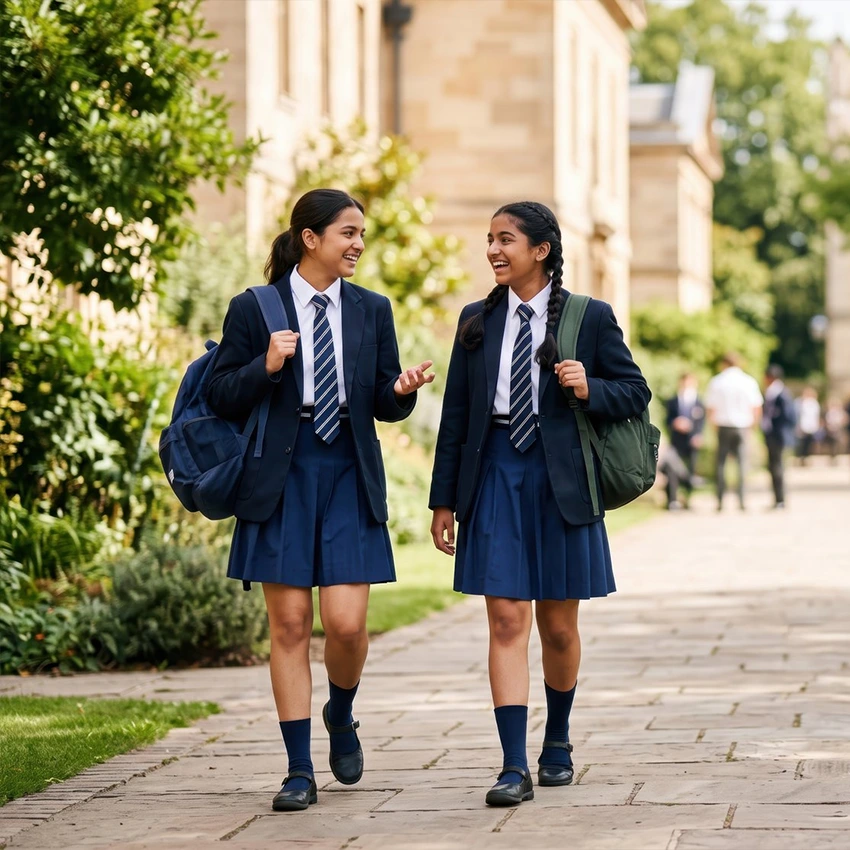
Independent schools where pupils live on site during term time, with full academic, pastoral and extra-curricular provision. Accepting pupils from age 7 through to 18, boarding schools are the traditional route into British education for international students.
We arrange placements at government-approved boarding schools with full board. See UK Boarding School Admissions for entry requirements and key dates.
Browse UK Boarding Schools
Our Services

Summer Schools
Short residential courses held during the summer holidays, usually on boarding school or college campuses, combining English language tuition with academic tasters, sport, activities and excursions. They suit international students, typically aged 8 to 17, visiting the UK for a short course.
We arrange places through our Summer Junior Programme.
Browse UK Summer Schools
Our Services

Colleges
Sixth form, tutorial and pre-university colleges specialise in A Levels, International Foundation Year and other pre-university courses for students aged 16 and over. They offer intensive teaching in smaller classes and a more independent style of study, bridging the gap between school and university.
We place students at selected colleges where we hold a direct partnership. See UK Pre-University Admissions for more information.
Browse UK Colleges
Our Services

Universities
UK universities offer undergraduate and postgraduate degrees respected by employers and academics worldwide, from Bachelor's programmes through to Master's and PhD study, for students aged 18 and over who meet the entry requirements of their chosen course.
We place students at selected universities where we hold a direct partnership. See our University Admissions for entry routes for September and January intake.
Browse UK Universities
Our Services

 English